

Matcha Tea, The Bridge To Low Caffeine
Caroline MacDougallIn just the last two decades, a new tea – new anyway to the US market – has roared into popularity. From the same plant that gives us black tea and green tea – Camellia sinensis that is - but grown differently to produce a brilliantly green leaf, Matcha tea has suddenly become the tea of choice for people who want a healthy, low caffeine tea despite its pricey cost and strong flavor profile.
The story of Matcha

Although only recently discovered by Western tea drinkers, matcha tea has evolved to its current form over hundreds of years. Originally the tea of choice for Zen monks needing to stay awake during long hours of meditation, seeds of matcha were brought to Japan by a Zen monk returning from a pilgrimage to China. He gave some of the seeds to a monk living in the Uji region of Japan where the tea quickly adapted to the soil and climate. To this day, Uji is the premier growing region for Matcha.
As Japanese farmers in the Uji region began experimenting with growing Matcha tea, they discovered that if they covered the plants with shade during the last few weeks of growth, the leaves would develop a deep shade of green due to their increased level of chlorophyll. This bright green color is identified with superior qualities of Matcha tea.

Mixing powdered tea leaves into hot water, which is how Matcha is traditionally prepared, was adopted by Zen monks from the tea preparation practice popular among China’s royalty and elite. Used in traditional tea ceremonies that were designed by those same Zen monks to encourage mindfulness, Matcha’s popularity grew during the last century in Japan as a tea enjoyed by connoisseurs. However, it still was expensive compared to green tea.
This century, Matcha has become adopted worldwide as curious Westerners have explored all types of tea varieties. The health benefits of Matcha have attracted enthusiastic tea drinkers who find the vibrant green tea also offers a new taste experience.
The science behind Matcha’s health benefits
Science has delved into the antioxidants in Matcha leaves to discover a group called catechins, which are a type of flavonoids known for supporting heart health, balancing metabolism, and protecting cells from oxidative stress.  Matcha’s especially high concentration of one of the most potent catechins, called EGCG, is linked to both cardiovascular support and healthy weight management. EGCG also helps enhance brain function, reduces inflammation and acts as a prebiotic nourishing the gut microbiome. Matcha leaves, which are harvested when they are young and protected from oxygen while being stored in darkness, have the highest level of catechins of any green tea.
Since Matcha tea leaves are ground to a fine powder and consumed as part of the tea rather than filtered out like green tea leaves, the amount of catechins in a cup of Matcha are highly concentrated in comparison.
Matcha’s gentler caffeine effect

Unlike coffee, which can put your body on the fight-or-flight rollercoaster by stimulating the release of stress hormones, Matcha offers a smoother lift.
Yes, it contains caffeine, but about a third as much as a typical cup of coffee. More importantly, Matcha pairs caffeine with L-theanine, an amino acid that promotes calm focus.
Research shows that L-theanine helps slow the absorption of caffeine, reducing those jittery spikes and sudden crashes many people experience after drinking coffee. Instead, you get a steady stream of alertness, which the Zen monks thought of as “calm energy”.
For anyone sensitive to coffee’s effects—like rapid heartbeat, anxiety, jitters or digestive upset—Matcha provides a gentler alternative that helps coffee drinkers ease off high caffeine consumption.
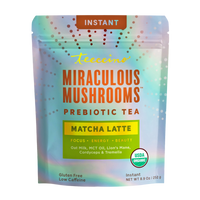
Surprise! Teeccino is launching Miraculous Mushrooms Matcha Latte

I know it is a departure for Teeccino to launch a tea that contains caffeine and additionally doesn’t taste like coffee. So what convinced me to do it?
I’ve heard from so many customers over the last 30 years how hard it is for them to quit coffee and reduce caffeine, especially in the beginning. Teeccino’s Kick The Caffeine Habit Program that weans you gradually off caffeine is great for the highly motivated, but others still want a boost from a bit of caffeine.
Looking at all the natural sources of caffeine, I wanted to focus on the ones with the highest health benefits that are low in caffeine.
Two plants stood out: Cacao and Matcha. They share the same antioxidant group of catechins including EGCG, which by the way, carob contains too. Delivering more of these important antioxidants to our customers’ cups aligns with our goal of producing products that promote optimal health.
Roasted Cacao with adaptogenic mushrooms

Cacao is roasted so its flavor is naturally complementary to Teeccino’s coffee-like flavor. I already use it as a flavoring component in Teeccino’s chocolate blends, and thus it was a natural choice to make a very low (5 mg approximately) caffeine blend based on cacao for our new Miraculous Mushrooms collection.
Teeccino’s new Instant Cacao + 5offers a very gentle lift with theobromine being its main stimulant and its neurotransmitter, anandamide, contributing to a blissful feeling. The 2500 mgs of 5 adaptogenic mushrooms produce even more health benefits with all the deliciousness of a chocolaty blend that you can’t taste the mushrooms in. Definitely a great bridge from the caffeinated life!
Turning Matcha into a drink coffee lovers would like

Matcha, on the other hand, has such a different flavor profile from Teeccino. It isn’t roasted. It is even protected from naturally fermenting as tea leaves do when they are exposed to oxygen so it doesn’t have the dark color of black tea. But Matcha’s grassy, umami flavor is enhanced by growing the tea plant in the shade to soften its normal astringency. Only young leaves are harvested to lower bitterness.
Matcha’s abundant high quality antioxidants and its rich source of chlorophyll, which is a natural detoxifier and prebiotic, convinced me that Matcha should join the Teeccino Miraculous Mushrooms family. With approximately 30mg of caffeine in a serving, Matcha’s naturally increased level of L-theanine helps mitigate caffeine’s side effects.
Making it more acceptable to coffee drinkers was the challenge though. I found enhancing Matcha with creamy oat milk and coconut milk plus MCT oil for a rich mouth feel masked Matcha’s astringency and bitterness.

Combined with Miraculous Mushrooms’ lion’s mane extract for mental clarity and focus, cordyceps extract for endurance and balanced energy, and tremella extract for beauty from the inside out, Teeccino’s new Instant Miraculous Mushrooms’ Matcha Latte produces an indulgent drink with a potent health impact.
I’m caffeine sensitive, yet I was able to drink small cups of Matcha Latte without getting jittery from its caffeine. Perhaps the creamy fats help slow the absorption of the caffeine. The three mushrooms also help reduce caffeine’s effect by contributing their adaptogenic properties that lower the stress which caffeine can produce.
Of course, you have to test it on your own body to see how it affects your system, which is the most accurate laboratory you have!
One more very important thing…

I selected organic Matcha. Tea leaves are typically sprayed with pesticides. Buying certified organic Matcha was the only choice I could make. It isn’t easy to come by. Matcha is in huge demand worldwide and there is a lot of stress on the supply. Organic is rarer still.
Chinese-grown Matcha just didn’t sit right with me either. The taste and color is just not up to the high standards set by the Japanese, who have been growing, harvesting and grinding Matcha for centuries. So our Matcha Latte uses only a high grade of organically grown Matcha from Japan.
Happy National Coffee Day!
If you need a bridge from the caffeinated lifestyle or if you want a bit of caffeine but still intend to keep your energy clean and balanced, I highly recommend you give both of Miraculous Mushrooms’ new blends, Cacao + 5 and Matcha Latte a try.
Monday September 29th is National Coffee Day. Matcha Latte is launching shortly thereafter so watch for our announcement. Cacao +5 is available now. Celebrate National Coffee Day with some of our new Instant Teeccino Herbal Coffees and Lattes. We couldn’t make it any easier for you to keep your energy steady and balanced and your stress levels as low as possible!
Monday September 29th is National Coffee Day. Matcha Latte is launching shortly thereafter so watch for our announcement. Cacao +5 is available now. Celebrate National Coffee Day with some of our new Instant Teeccino Herbal Coffees and Lattes. We couldn’t make it any easier for you to keep your energy steady and balanced and your stress levels as low as possible!

3 comments
You site is something that is hard to navigate to get to products. Interested in th matcha
———
Teeccino replied:
The fastest way to find a specific product you want is to use the search bar at the top of the home page. Simply type in “Matcha” and it will show you the product. The other way to reliably find it is to go to the Instants collection under “Shop”. Matcha will appear with the other Instant Teeccino products.
Thanks for your interest in our new Matcha Latte! !
Caroline MacDougall Founder / CEO Teeccino
805-689-0160 cell 805-966-0999 × 103 office ________________________________
I did not finish – any way you can offer matcha with less caffeine? I have been off caffeine for many years
———
Teeccino replied:
Depending on what you drink, there is more or less caffeine in it. Our Matcha Latte ha approximately 30mg of caffeine per cup. If you want to stay caffeine free, this is not the beverage for you. Check out our Miraculous Mushrooms Adapt & Protect instead!
Caroline MacDougall Founder / CEO
Teeccino Herbal Coffees & Roasted Herbal Teas https://teeccino.com/
805-966-0999 office 805-689-0160 cell
Join Caroline MacDougall’s Healthy Tips Newsletter at https://teeccino.com/#newsletter-signup
Love teccino. Have been off caffeine for mLove unsweet organic matcha with Half and half. . Any way you can offer matcha with less caffeine??
———
Teeccino replied:
Our Miraculous Matcha Latte may or may not have less caffeine than your unsweet organic matcha. I suggest testing it on your own body to see if it affects you, but I suspect that if you’re drinking matcha with half and half, our latte will be similar but slightly sweet from the dates.
Caroline MacDougall Founder / CEO
Teeccino Herbal Coffees & Roasted Herbal Teas https://teeccino.com/
805-966-0999 office 805-689-0160 cell
Join Caroline MacDougall’s Healthy Tips Newsletter at https://teeccino.com/#newsletter-signup